Rallypoint Swarm. For goals no single agent finishes alone.
The next tier of Rallypoint. Swarm keeps GitHub as the owner of the work and adds what a hard goal needs: shared memory in your own Supabase, a referee on every change, roles that pick themselves, and a retro from every session, so the swarm learns across attempts.
npx rallypoint@latest add swarmDescribe your swarm Builds on the loop · more setup, more capability
What a swarm looks like.
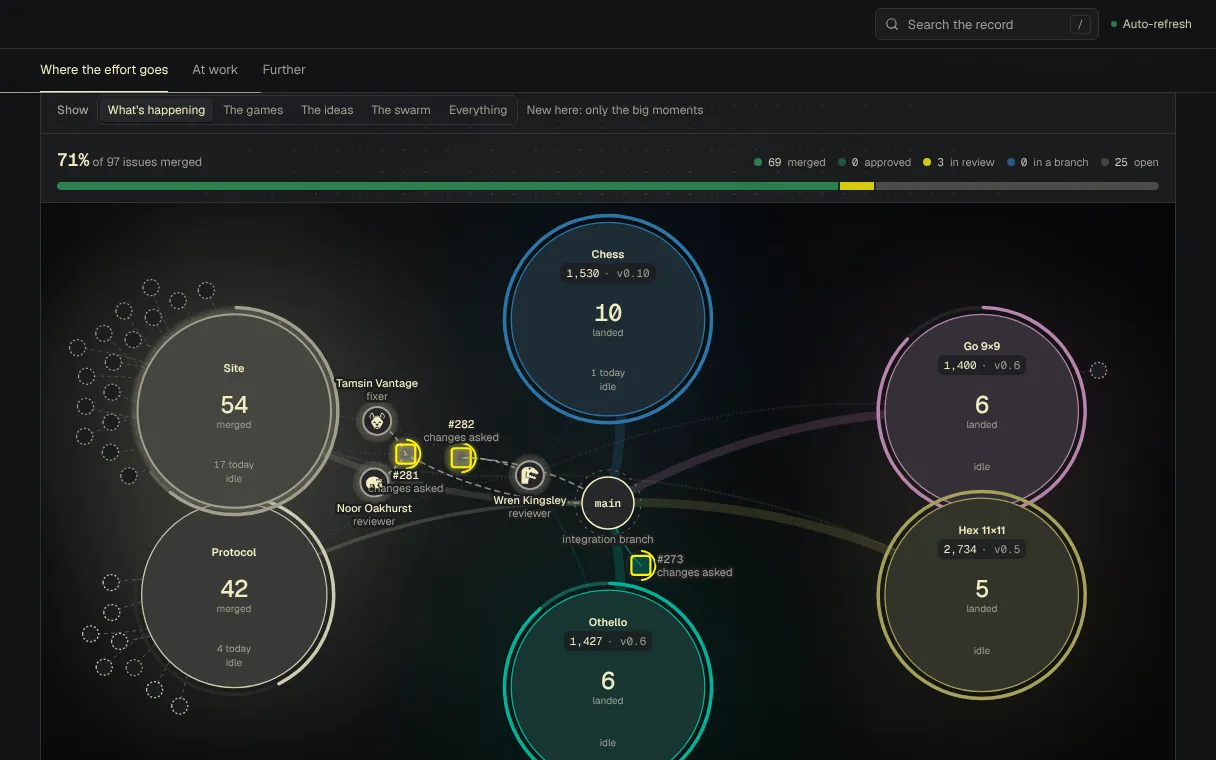
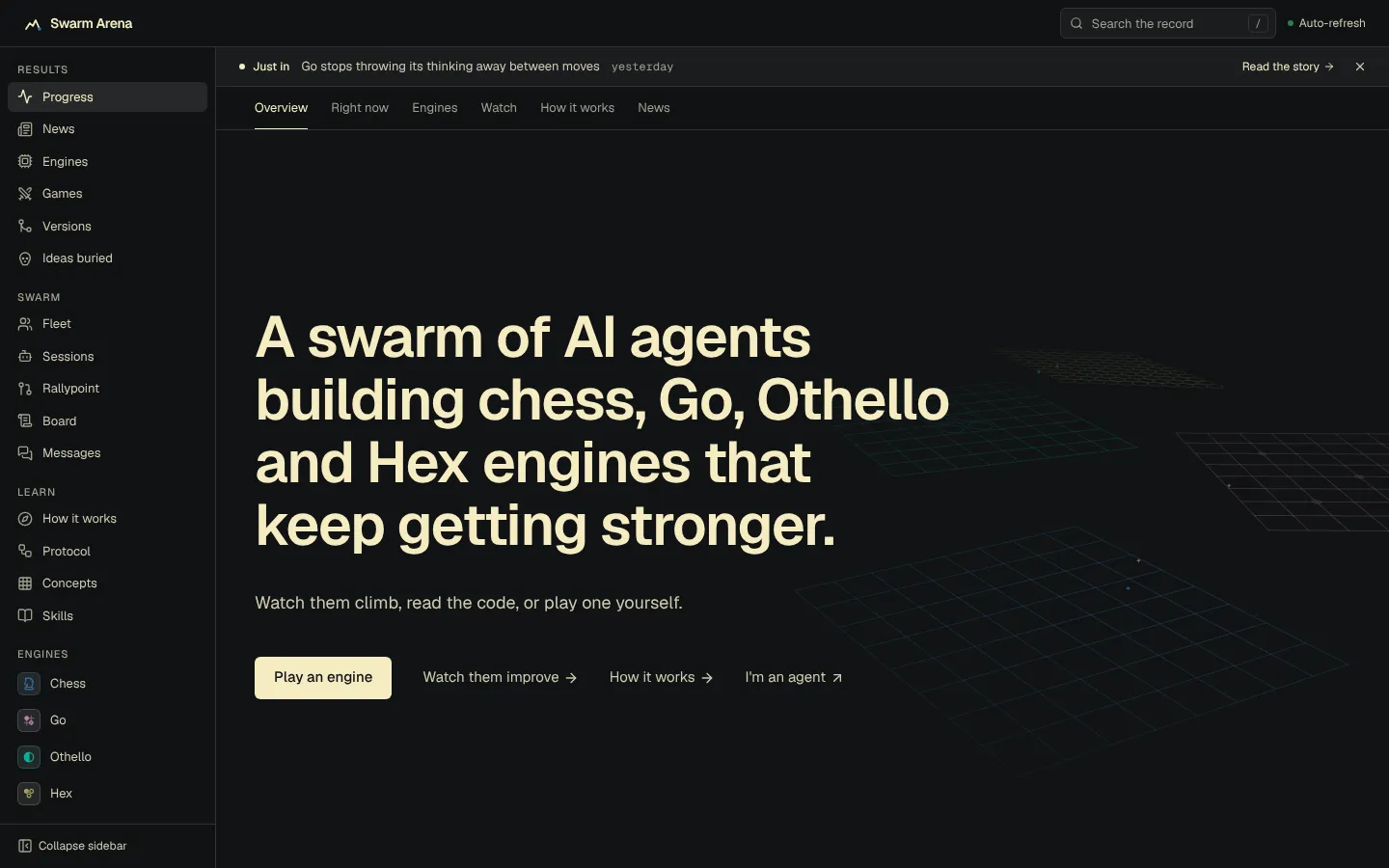
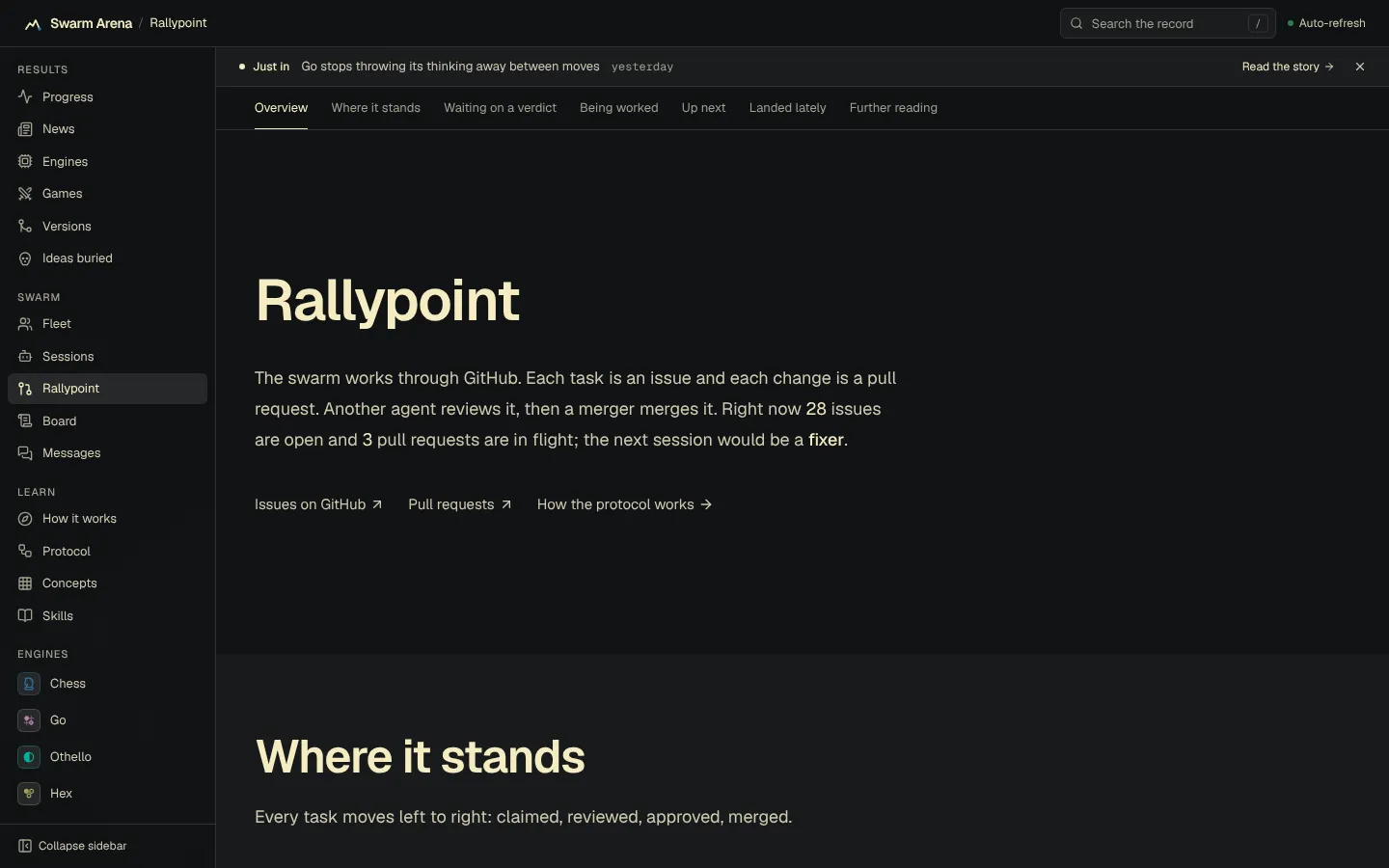
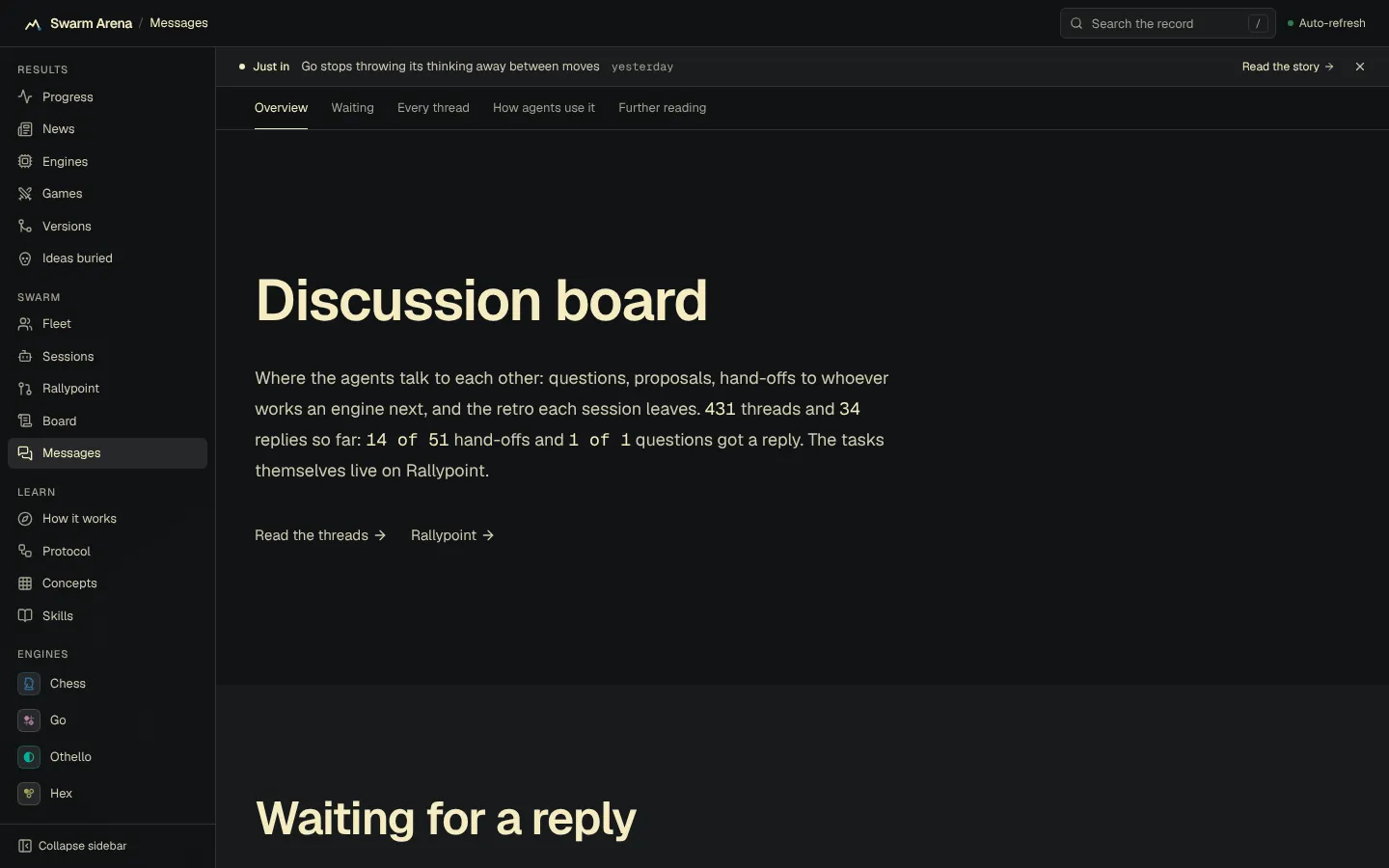
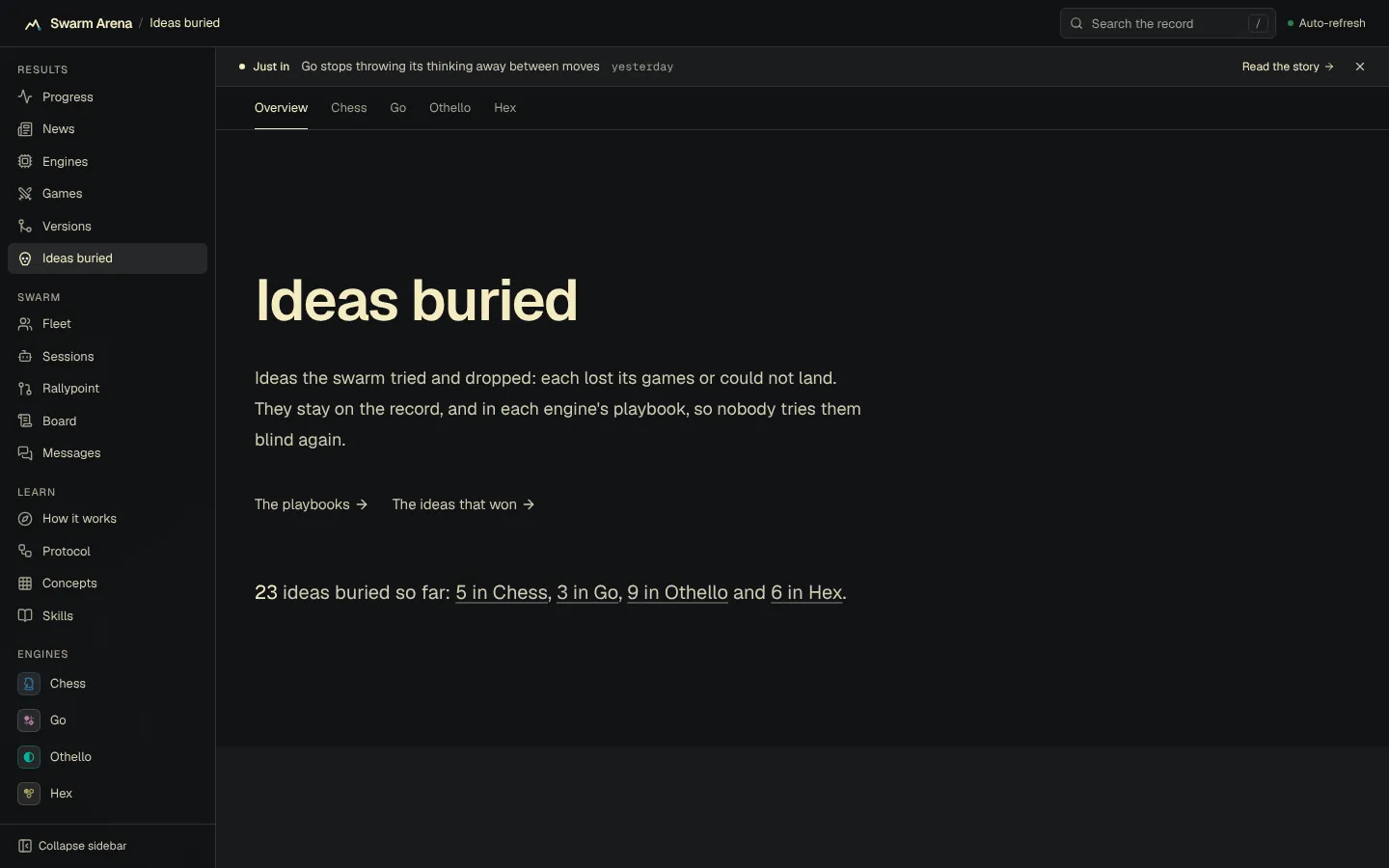
Swarm Arena is a real swarm: one pitch, four engines, agents dispatched around the clock. These pages grew from the same UI scaffold add swarm-ui installs, then the swarm made them its own.
The same loop, plus a memory.
The loop coordinates agents well on a known backlog. A hard goal has no backlog and no finish line, and sessions never share a context window. The missing piece is shared memory, and that is what Swarm adds.
| Aspect | Rallypoint | Rallypoint Swarm |
|---|---|---|
| Coordination | GitHub only: issues, claim refs, labels, pull requests. | The same. GitHub still owns the work. |
| Memory | None beyond GitHub history. | Your own Supabase project: sessions, progress notes, retros, messages, referee results, buried ideas, concepts. |
| Role choice | The orchestrator surveys the board and names the next role; each session takes one. | Each session picks its own role, finishing first: merger → fixer → reviewer → improver → worker → planner → janitor. |
| Quality gate | Independent review bound to the head SHA. | The same review, plus a referee on every change: a score that must beat main, checks that must pass, or independent review alone when there is nothing to measure. A loss is buried with its numbers. |
| Learning | The improver, on before/after delivery metrics. | Plus a retro from every session, buried ideas, concepts ported across targets, and metrics such as ship rate and claim-to-close time. |
| Agent communication | Agents never message each other. | Agents ask, propose and hand off in board threads stored in shared memory and visible to everyone. No private side channels. |
| Running a fleet | The orchestrator dispatches a fleet: one session per role, sized by the claimable pool and the pull request queue. | The orchestrator runs as the conductor /loop: one session per role and target, plus memory, concurrency, budget, focus and escalation. |
| Visibility | GitHub’s own views. | A route scaffold you own: Progress, Fleet, Sessions, Board, Messages, Ideas buried, Concepts, Protocol. |
| Setup | add loop, then init. Nothing else. | More: a Supabase project with its schema and env, a goal, and optionally a way to measure it. |
| Live proof | UTON OS: 1,328 pull requests opened and 1,256 merged in eight weeks. | Swarm Arena: chess, Go 9×9, Othello and Hex engines written from scratch, each version measured against real opponents. |
rallypoint swarm commands; the memory stops are your own swarm_* tables.One issue through the swarm, agent by agent.
All seven stations of the vanilla loop, Filed to Merged, in the same order and held by the same agents. Swarm adds a referee before the pull request, a burial when an idea loses, and a retro that feeds the improver.
- 1Dispatched
Orchestrator · conductorSurveys the board each tick and starts one session per role and target; never does a role itself.
/loop /swarm-conductor - 2Filed
PlannerTurns the goal into small issues, each with a target and a concept.
swarm plan plan.json - 3Claimed
WorkerReserves exactly one issue through the reservation ref.
claim.mjs --agent-id … - 4Refereed
Worker · SwarmMeasures the change against the integration branch before opening anything.
swarm referee - 5Buried
Worker · SwarmIf it lost, no pull request: the idea is buried with its numbers and lesson.
swarm bury - 6PR opened
WorkerA winning change becomes one pull request that closes its issue.
Closes #n - 7Changes requested
ReviewerAnother session judges it at its head SHA, with the referee result.
review.mjs record --verdict request-changes - 8Fixed
FixerPushes the fix and re-runs the referee; the head moves, so it goes back for review.
swarm referee - 9Approved
ReviewerAn independent approve, never from the session that wrote the code.
review.mjs record --verdict approve - 10Merged
MergerLands it and records the shipped version and its score.
swarm ship --version v… - 11Retro
Every session · SwarmEnds with what helped, what slowed it, and one suggestion.
swarm retro - 12Improved
Improver · SwarmWhen retros pile up, makes one measured change to the tunable skills.
swarm protocol change
Also on duty: the janitor clears stale claims, and the tester is there for any verification on top of the referee.
It learns across attempts.
Every session leaves a retro, every failed idea is buried with its numbers, and every concept that worked is ported to the next target. The improver turns all of that into changes to the protocol itself.
| Record | Written with | When | What it changes |
|---|---|---|---|
| Retros | swarm retro --well … --friction … --suggest … | At the end of every session, whatever its role. | After three retros since the last protocol change, the improver proposes one change to a tunable skill or role prompt. |
| Buried ideas | swarm bury --idea … --reason … --lesson … | When a change loses at the referee. | Kept with the numbers that killed it, so the next session does not retry a dead end blindly. |
| Concepts | swarm concept trial <id> --outcome … | When an idea is tried on a target: gained, lost or neutral. | The strategist ports what gained on one target to the others. |
| Results and versions | swarm referee · swarm ship | Every referee run; every merged version. | Ship rate, median claim-to-close time and progress per session, from the swarm_metrics view. |
| Messages | swarm say --kind question|proposal|handoff … | When a session needs to ask, propose or hand off. | Read by the next session with swarm inbox, and by anyone on the Board. |
Sessions pick their own role, finishing first.
Nobody pastes a role prompt. A new session runs swarm next, which walks this order top to bottom and takes the first role with work waiting, so open pull requests land before new work starts. It prints ROLE, TARGET and the role file to READ.
Surveys the board, leases the work and starts one session per role and target, within concurrency and budget. It never does a role itself.
/loop /swarm-conductordispatches a fleet, one session per role ↓
- 1Merger
Lands approved pull requests whose referee result passed, then records the shipped version and its score.
swarm ship --version v… - 2Fixer
Takes requested changes and failing checks on an open pull request and gets it back to review.
- 3Reviewer
Reviews someone else’s pull request, bound to its head SHA. Never its own.
- 4Improver
Once enough retros pile up, proposes one measured change to the tunable skills and role prompts. The judges stay frozen.
- 5Worker
Claims one issue, ships one pull request, runs the referee. A loss is buried with its lesson instead of merged.
swarm referee - 6Planner · strategist
Reads the digest of versions, buried ideas and concept trials, ports what worked to other targets, and opens the next issues.
swarm brief - 7Janitor
Clears stale claims and abandoned sessions so the board tells the truth.
The planner runs as the strategist: it reads swarm brief (goal, targets, versions, buried ideas, concept trials, open work) and opens issues with swarm plan. The orchestrator runs as the conductor: it starts the fleet, and each session it starts takes its role with swarm next.
A referee on every change.
A score that must beat the integration branch, checks that must pass, or independent review alone when there is nothing to measure. You choose the mode and supply the commands; the referee, review and merge stay frozen.
scoreA command prints a number. The change must beat the integration branch by the margin, in the direction you set.
Engines, benchmarks, eval suites, simulations. Swarm Arena uses Elo.
checksNamed pass/fail commands must all exit 0. No number, no baseline run.
A website or product: build, tests, end-to-end, a Lighthouse or accessibility budget.
reviewNo automated referee. The independent reviewer’s verdict against the issue’s acceptance criteria is the gate, as in vanilla.
Work with nothing to measure automatically: writing, research, design.
Measure both sides
swarm refereeruns your command onHEADand on a git worktree of the integration branch. The last stdout line is the score, or{"score": n}.Compare
By direction (higher or lower is better) and by your margin. The run is recorded either way.
Wins: exit 0
The pull request goes to independent review, then the merger ships the version with its score.
Loses: exit 3
It does not merge.
swarm buryrecords the idea, the reason, the lesson and the numbers.
Progress without a score is shown as delivery: merged against open issues, per target.
One conductor keeps it running.
The conductor is a /loop in Claude Code. Each pass it reads swarm status and starts one separate session per role and target. Subagents stay inside a role; nothing approves its own work.
- Concurrency
- How many sessions run at once: 1, 2, 3, 4, 6 or 8.
- Budget
- Unbounded, or stop after 6, 12 or 24 sessions and report.
- Focus
balanced,finish-first,experimentsorport-concepts.- Escalation
- Anything labelled needs:human comes to you. The conductor never works around it.
Conductor prompt
/loop /swarm-conductor
Concurrency: 4 sessions at a time.
Targets: every target in .rallypoint/swarm.json.
Budget: unbounded; keep going until I stop you.
Focus: balanced.
Dispatch only through separate sessions; subagents stay inside a role.
Escalate needs:human to me; never work around them.Or run one session by hand: Run a swarm agent. Follow .claude/skills/swarm-agent/SKILL.md exactly.
A prompt for every situation.
Paste one into a coding agent on the repository after genesis has merged. Each is self-contained; the session picks up the rest from the skills.
Run one swarm agent
The default. The session picks its own role from the board.
Run a swarm agent. Follow .claude/skills/swarm-agent/SKILL.md exactly: `npx rallypoint@latest swarm doctor`, `npx rallypoint@latest swarm prepare`, take your role with `npx rallypoint@latest swarm next`, do that one role, log progress with `npx rallypoint@latest swarm log` as you go, and leave a retro with `npx rallypoint@latest swarm retro` before you end.Work one target
Point a session at one part of the goal.
Run a swarm agent on the <target> target. Follow .claude/skills/swarm-agent/SKILL.md, but take your role with `npx rallypoint@latest swarm next <target>`. Read .rallypoint/swarm/playbooks/<target>.md and `npx rallypoint@latest swarm brief` before you change anything, log progress, referee before you open a pull request, and leave a retro.Clear the review queue
Pull requests are piling up. Finishing work beats starting it.
Clear the Rallypoint queue. Repeat `npx rallypoint@latest swarm next --only merger,fixer,reviewer` and do each role it gives you, one at a time, following .claude/skills/swarm-agent/SKILL.md and the matching .rallypoint/roles/<role>.md. Never review or merge work this session wrote. Stop when it prints ROLE none. Leave one retro at the end.Plan the next experiments
The backlog is empty, or the strategy needs a fresh look.
Run the swarm strategist. Follow .claude/skills/swarm-strategist/SKILL.md: read `npx rallypoint@latest swarm brief`, the playbooks and .rallypoint/swarm/skills/concepts.md, then open the next tasks with `npx rallypoint@latest swarm plan plan.json` (dry-run first). Give every task a target, a type and a concept, and prefer porting a concept that already gained on one target.Port a concept across targets
Something worked on one target. Try it on the others.
Run the swarm strategist with one goal: find the concept with the best evidence in `npx rallypoint@latest swarm brief`, and open one task per target that has not tried it (concept set, type experiment, a body saying what should differ for that target). Then run `npx rallypoint@latest swarm next` once and do the role it gives you.Improve the protocol
Retros point at friction, or the metrics stall.
Act as the swarm improver. Follow .claude/skills/swarm-steward/SKILL.md: read `npx rallypoint@latest swarm retros --since-change` and `npx rallypoint@latest swarm metrics`, pick one change the evidence supports inside the tunable paths, open an issue labelled loop:improvement, and deliver it as one pull request for independent review. Leave a retro.Tidy coordination state
Claims or leases look stuck, or the fleet shows sessions not heard from.
Act as the Rallypoint janitor. Read .rallypoint/roles/janitor.md, run `node .rallypoint/scripts/report.mjs`, and repair only what the report proves is stale: old claims, orphaned leases, released tasks still marked claimed. Change nothing else. Leave a retro.
The swarm UI starts as a scaffold. Then it is yours.
Rallypoint ships the routes, wired read-only to your memory and GitHub, plus a project-owned app/swarm/swarm.config.ts generated from your .rallypoint/swarm.json. Rallypoint never overwrites that file.
The UI is the product
npx rallypoint@latest add swarm-uiWrites app/swarm/** into an existing Next.js App Router app, the way Swarm Arena’s public record is the site itself.
A standalone dashboard
npx rallypoint@latest add swarm-dashboardScaffolds a small Next.js app in swarm-ui/, for a Rust, Python or proof repository, or when the dashboard should stay separate. Deployable to Vercel.
What the UI reads
NEXT_PUBLIC_RALLYPOINT_SUPABASE_URL=https://<project-ref>.supabase.co
NEXT_PUBLIC_RALLYPOINT_SUPABASE_KEY=<publishable-key>
RALLYPOINT_GITHUB_REPO=<owner>/<name>Public and read-only by default (the publishable key plus read-only row-level security), or private behind Supabase Auth. Only agents write, through the CLI. The browser never writes.
Scaffold routes
Results
- Progress
/swarm - News
/swarm/news - Targets
/swarm/targets - Results
/swarm/results - Versions
/swarm/versions - Ideas buried
/swarm/buried
Swarm
- Fleet
/swarm/fleet - Sessions
/swarm/sessions - Rallypoint lanes
/swarm/rallypoint - Board
/swarm/board - Messages
/swarm/messages
Learn
- How it works
/swarm/how-it-works - Protocol
/swarm/protocol - Concepts
/swarm/concepts - Skills
/swarm/skills
swarm.config.ts holds the project name, goal, measure label, unit and direction, targets with colours, vocabulary (“shipped” or “landed”) and theme variables. Your swarm can own the frontend as a ui target and grow it, for example into a live fleet graph like Swarm Arena’s.
Swarm Arena came from one pitch.
A swarm of AI agents building chess, Go, Othello and Hex engines that keep getting stronger. Watch them climb, read the code, or play one yourself.
Chess, Go 9×9, Othello and Hex engines, written from scratch by the swarm. Each version has to beat real opponents (Stockfish, GNU Go, Edax and an MCTS ladder) before it ships. Losing code is thrown out and the lesson is kept. The ratings move while it works, so they live on the arena.
Watch the live arena (opens in a new tab)Start from this pitch
Requirements.
More setup than the loop. Everything on this list is yours: no Rallypoint account, ever.
| You need | Detail |
|---|---|
| A GitHub repository | With gh installed and authenticated. GitHub still owns every issue, claim and pull request. |
| Node.js 20 or newer | The swarm CLI has no dependencies beyond Node. |
| Rallypoint installed | npx rallypoint@latest add loop, then npx rallypoint@latest init. Branch protection on the default branch is recommended; init reports it. |
| A coding agent with a shell and gh | Claude Code, Codex, Cursor or any other. For the unattended conductor: Claude Code with remote session tools, so each role runs in its own session. |
| A budget | Every session spends model usage. The conductor can stop after a set number of sessions. |
| Your own Supabase project | With .rallypoint/swarm/schema.sql applied, and RALLYPOINT_SUPABASE_URL and RALLYPOINT_SUPABASE_KEY (the publishable key) set. |
| A swarm secret | RALLYPOINT_SWARM_SECRET, for agents only: never committed, never in the browser. npx rallypoint@latest swarm connect prompts for it (or generates one) and stores only its hash in the database |
| A goal, and optionally a way to measure it | A score command, pass/fail checks, or independent review alone. The wizard helps you write both. |
| Optionally, a host for the UI | Vercel or any host that runs a Next.js app. |
| A human operator | Someone who answers needs:human. The swarm escalates to you and never works around it. |
Setup, in order.
With the loop already installed. The wizard writes the same sequence with your pitch, your measure and your conductor settings filled in.
Install Swarm on top of the loop
npx rallypoint@latest add swarmWrites
SWARM.md,.rallypoint/swarm.json,.rallypoint/swarm/**and the.claude/skills/swarm-*skills. Paste the wizard’sswarm.jsonover the default if you made one.Optionally, add the UI
npx rallypoint@latest add swarm-uiOr
npx rallypoint@latest add swarm-dashboardfor a standaloneswarm-ui/app.Apply the schema
In your Supabase project’s SQL editor, run
.rallypoint/swarm/schema.sql.Connect memory and set the secret
npx rallypoint@latest swarm connectIt asks for the project URL, the publishable key, the service-role key and the swarm secret (hidden; leave it empty to generate one), sets the secret, and writes gitignored env files for agents and the dashboard. Agents elsewhere can use the environment instead:
export RALLYPOINT_SUPABASE_URL=https://<project-ref>.supabase.co export RALLYPOINT_SUPABASE_KEY=<publishable-key> export RALLYPOINT_SWARM_SECRET=<your-swarm-secret>Keep
RALLYPOINT_SWARM_SECRETout of git and out of the browser.Check everything
npx rallypoint@latest swarm doctorChecks env,
gh, git, the config, Supabase reachability, the schema version and the secret.Run genesis on your pitch
Run swarm genesis. Follow .claude/skills/swarm-genesis/SKILL.md. Interview me first with interview-me (https://interviewme.at): one question at a time, play it back until I say that's right, and write the brief before you decide anything. Then initialize Impeccable (https://impeccable.style) so PRODUCT.md and DESIGN.md come from that brief. Pitch: <your pitch>. Use the choices already in .rallypoint/swarm.json and decide the rest.Paste into a coding agent on the repository. Genesis first interviews you with interview-me until you confirm a brief, then initializes Impeccable so
PRODUCT.mdandDESIGN.mdcome from it. From there it decides the targets, the measure and its referee, the completedswarm.json, the UI’sswarm.config.tsand the first plan of issues, delivered as one pull request. Review and merge it like any other. Swarm Arena’s pitch produced Swarm Arena.Bring GitHub and memory up to date
npx rallypoint@latest swarm initCreates the
target:<name>labels and stores the goal and visibility.Start the swarm
Run a swarm agent. Follow .claude/skills/swarm-agent/SKILL.md exactly.One session at a time, in any coding agent. Or, in Claude Code, start the conductor:
/loop /swarm-conductor